Showing posts with label Akash Missile. Show all posts

Saturday, 21 May 2011

Astra Flight Tested

Update : A flight-test of air-to-air missile Astra failed on Friday after it developed a snag during a manoeuvre after being launched from the Integrated Test Range at Chandipur in Orissa. The missile has been developed by the Defence Research and Development Organisation (DRDO).


DRDO's Chief Controller (Missiles and Strategic Systems) Avinash Chander said the mission could not be completed as the missile developed a “control-related fault” when a manoeuvre was attempted. “A snag developed during a manoeuvre. The missile lost control after it reached a certain height. A team is analysing the data.”


Astra, a single-stage missile, is envisaged to intercept and destroy enemy aircraft at supersonic speeds in a head-on mode at a range of 80 km.


It can carry a 15-kg warhead.


There are plans to equip fighter aircraft Sukhoi-30, Mirage-2000, MiG-29 and Light Combat Aircraft Tejas with it after the completion of its air-launched trials.

BALASORE (ORISSA): India on Friday carried out the ballistic flight test of Astra -- Beyond-Visual-Range Air-to-Air Missile -- from the Integrated Test Range at Chandipur near here today.

The missile was fired around 0950 hours, Defence Research and Development Organisation (DRDO) sources said, adding two more tests are likely to be conducted in the next two days.

The missile is envisaged to intercept and destroy enemy aircraft at supersonic speeds in the head-on mode at a range of 80 km and in tail-chase mode at 20 km.

"The main purpose of today's trial is to gauge the performance of the motor, propulsion system and the configurations of the vehicle and aero-dynamics evaluation," said a DRDO scientist.
However, we are yet to know whether the test has been successful. Two more tests are likely to be conducted in the next two days," they said

The data is being analysed by the scientists to ascertain the outcome of the trial.

Astra, which uses solid propellant, can carry a conventional warhead of 15 kg. It is 3.8-meter long and has a diameter of 178 mm with an overall launch weight of 160 kg.

The missile could be launched from different altitudes. It can cover 110 km when launched from an altitude of 15 km, 44 km when fired from an altitude of eight km and 21 km when the altitude is sea-level.DRDO officials said it is more advanced than the similar class of missiles of the US, Russia and France.

The missile, after its final trials, would be integrated with fighter aircraft Su-30 MKI.

Friday, 22 April 2011

Full-Speed Ahead For MASS

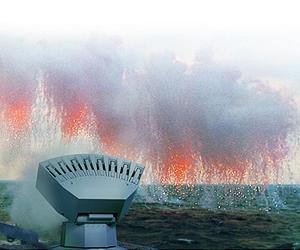
To protect their fleets from missile attacks, the navies of Peru, Finland and Germany have all ordered MASS, Rheinmetall's "Multi Ammunition Softkill System", a state-of-the-art decoy system for protecting frigates, corvettes, minesweepers and patrol craft. In winning these three orders, MASS has once again outclassed its international rivals as well as gaining a foothold in the South American market. The three orders are worth a total of approximately EUR15.5 million.
As part of a comprehensive modernization of its LUPO-class frigates, the Peruvian Navy has placed an order with Rheinmetall Defence initially to equip two ships with the MASS naval countermeasure system. The contract also includes an option for equipping two more frigates of this class within the next two years.

The German Navy has awarded Rheinmetall with another follow-on order for equipping its minesweepers with MASS, reflecting the great emphasis Germany places on force protection.

Following immediate retrofitting in 2008 of two countermine vessels in response to an urgent operational requirement (UNIFIL), two more vessels of the same class were equipped with MASS in 2009. Under the current order, two more countermine vessels will be equipped with a MASS two-launcher configuration with integrated detection unit.
MASS (Multi Ammunition Softkill System) decoy launcher of the Finnish missile boat Pori.

The Finnish Navy, opting once again for MASS, has contracted with Rheinmetall Defence to retrofit six RAUMA-class missile boats. In 2002, Finland - the system's pilot customer - had its Hamina-class fast attack craft outfitted with MASS technology.
Since its market launch in 2002, customers around the globe have ordered no fewer than 172 launcher units.


Superior protection with MASS
Guided missiles and other projectiles pose a constant threat to civilian shipping and naval vessels alike. MASS protects ships from attacks using advanced, sensor-guided missiles on the high seas and coastal waters as well as from asymmetric, terrorist-type threats. MASS fires decoy rounds which lure incoming projectiles away from their intended target.

Fully automatic, the MASS naval countermeasure system offers significant tactical, operational and logistical advantages and can be installed onboard any vessel. Moreover, it can be integrated into any command and control system or operated in standalone mode.

The MASS system's innovative, programmable omnispectral rounds assure protection in all relevant wavelengths of the electromagnetic spectrum (radar, infrared, laser, EO, UV). Numerous international test campaigns have demonstrated its effectiveness in compelling fashion.

MASS with integrated detection unit
Featuring an integrated detection unit, the "MASS ISS - Integrated Sensor Suite" represents an innovative departure in naval electronic warfare. Jointly developed by Rheinmetall Defence and Saab (Electronic Defence Systems), this new version of MASS comes with sensors capable of detecting both radar and laser threats.

Thursday, 21 April 2011

IAF SWAC to deploy Su-30MKI squadrons, Akash SAM and radars


South West Air command
On his visit to Jodhpur Air Marshal Gogoi informed the media that due to the increased threat perception from Pakistan and China combo, IAF will look to strengthen itself by having a permanent base for Su-30 squadrons at Jodhpur. He is the AOC-in-C of SWAC(South West Air Command)
Air marshal Gogoi was on a three-day visit to the Jodhpur air base, the headquarters of SWAC, his first after assuming command.

Talking about the deployment of the DRDO-developed medium range, surface-to-air, Akash missile, air marshal Gogoi, two squadrons of these missiles were soon be deployed, of which one will be at Pune, which falls under SWAC's command. The other deployment would be at Gwalior.
Besides this, six more squadrons will be deployed in the region to check any threat from China," he added.


A small note about Akash missile The Akash missile system consists of radars, mobile launchers, control canters, battlefield management software, and other support systems (see the picture above). Its radars simultaneously can track 64 objects and guide 12 missiles at most. The Akash missile is 5.78m long and weighs 700kg with a warhead of 60kg. It can destroy targets 25 km away and has a supersonic speed of 600m/s (1.8 mach). It has an 85 per cent kill probability.


The Indian Air Force (IAF) will primarily use the system for attacks from unmanned combat aerial vehicles (UCAV), aircraft, and missiles. The indigenous Akash is said on the same class as the U.S. Patriot, Israel’s Barak, and U.K.’s SAM missile systems, but its speed and range are actually much less. Compared with Akash’s 25km and 1.8 mach, all these foreign medium range missiles feature a range of 70 to 150 km and a speed of 4 to 5 mach.
Akash
The IAF had been ever reluctant to acquire the Akash missile system before. In 2008, several senior officers of the Indian Air Force expressed their un-satisfaction to the Akash system in the Indian Western Air Force Command Meeting. One senior officer suggested the Indian air force not to purchase the Akash, saying the IAF needed more maneuverability and greater range from the missile system. 


After the IAF has been assured that the missile system will be improved batch by batch and will go concord with the operating requirements of the IAF, the Akash finally was allowed to join into the IAF family.
Besides placing the order to the indigenous Akash, the IAF still has not slowed its steps to buy air defensive missiles from abroad. According to Israel media, in Nov. 2009 Israel and India has just signed a 1.1 billion US dollars contract for purchasing Israeli Barak-8 surface-to-air missile systems, which will be handed over to the IAF six to eight years later before 2017.


The air marshal also said the IAF was expecting an increase in the number of fighter squadrons after 2012. The force has been facing shortage of aircraft for a considerable period of time.(Please note how our defense preparedness is suffering)

"The number of aircraft squadrons is going down so some bases do not have the required squadrons. Only after 2012, when we start to increase the number of squadrons, we can expect permanent basing," Gogoi said. He was referring to the absence of permanent basing of aircraft squadrons at many air bases.

He also revealed that SWAC was in the process of strengthening its surveillance capabilities by inducting a few state-of-the-art, medium power radars (MPR). The MPR is an AESA system developed for the IAF, which will be able to detect small targets at ranges in excess of 300 km.

"The SWAC will be the first air command to have this modern radar technology," air marshal Gogoi said. "We have already received it and are in the process of making it functional in Gujarat," he said on the last day of his visit here.

Gogoi further said proposals are on to develop the Deesa airport as a full-fledged air base. "Considering the strategic importance of this base and the development taking place around it, we have mooted a proposal to the defence ministry worth over Rs3,000 crore as first phase to strengthen the infrastructure of this base and we are going to push this proposal during the commanders' conference scheduled shortly," he said. Deesa like Phalodi air base, is close to the Pakistan border.

Air marshal Gogoi was commissioned into the fighter stream of the Indian Air Force in 1973. He has flown over 3000 hours on various aircraft, and is a qualified flying instructor and a fighter combat leader.
Air marshal Gogoi was director general, air operations, at Air HQ prior to his current appointment.
He is a recipient of Ati Vishisht Seva Medal and Vishisht Seva Medal.