Showing posts with label Russia. Show all posts

Thursday, 29 May 2014

Russians want to place three GLONASS ground stations in India

It has been in the making for quite a few years but now senior Roscosmos official confirmed that they would like to outsource GLONASS navigation equipment manufacturing to India.

It is believed that the countries may start the process in earnest after a visit from a Russian team in June or July.More information could be found at the page inside the frame.
Things are moving in a direction where India may sign an agreement with the Russians for the deployment of three GLONASS stations here. This was confirmed to some newspapers by  Sergey Savelyev, deputy head of Roscosmos.

Unknown to us is the fact that we have been using Russian tech for some time now. Not only civilian applications like IPhone4 but India Army uses these signals too. Some of the satellites for this network has been launched from India. Many big chip set manufacturer in India utilize this technology some of them are  Qualcomm, Broadcom, STMicroelectronics.

“We would like to place our own GLONASS ground stations here, as well as jointly produce user equipment and work together on the implementation of technologies such as the ERA-GLONASS. It would be interesting to create a joint venture in India,” Savelyev said.

Some of the related news articles could be found here

India strikes deal with Russia on Glonass
SANDEEP DIKSHIT 
Now, it can get precision signals from Russian constellation of satellites
A day before Prime Minister Manmohan Singh arrived here last weekend for his annual summit with the Russian leadership, an Indian defence team of scientists and defence brass returned to Delhi after inking an agreement for receiving precision signals from Glonass, Russian constellation of satellites. 

These signals will allow missiles, including those fired from nuclear submarine Chakra, to strike within half a metre of distant targets.

Glonass is an alternative to the U.S.-controlled Global Positioning System (GPS).
.
Indian military's access to Glonass has been considered important enough to find a mention in half-a-dozen joint statements issued after India-Russian annual summits.

As has been the case earlier, the issue lay in an indeterminate state for long time after Prime Minister Manmohan Singh discussed it with Russian President Dmitry Medvedev during their meeting in Delhi last year.

india-strikes-deal-with-russia-on-glonass


Russia and India navigational satellites launched
by Simon Chester on 1 April, 2014 in GPS & Navigation 

On 24 March, a Russian Soyuz rocket launched a Glonass navigation satellite into orbit from Russia’s northern Plesetsk space center, inserting a Glonass-M satellite into orbit where it is now functioning normally.

Additionally, India’s latest navigational satellite, IRNSS 1-B, will be launched on board a PSLV C-24 rocket from Satish Dhawan Space Centre at Sriharikota on 4 April. The Glonass-M satellite (designated number 54) was manufactured by ISS-Reshetnev and is designed for a seven-year operational life.

It is planned that five satellites of the Glonass-M series will be delivered into orbit in 2014 in order to maintain the national navigation system GLONASS in its full operational capability. Three satellites will be launched in a batch of three, while the rest two will fly into orbit in two single launches.
Russia and India navigational satellites launched

Sunday, 4 March 2012

Israeli's Stabbed Georgia In The Back, Helped The Russians To Hack Georgian Drones

A swap deal between Russia and Israel in 2008 provided the Russian military with secret codes for Georgian drones, while Jerusalem obtained access to information on Iranian missile systems, according to fresh publications by Wikileaks.

Georgia purchases its unmanned aerial vehicles from Israel, which later gave Moscow the "data link" code in exchange for codes for Tor-M1 missile complexes that Russia sold to Iran, said a leaked letter attributed to Stratfor private intelligence company.

Whistleblowing site Wikileaks announced on Sunday that it started to publish some five million emails by Stratfor, or Strategic Forecasting Inc., a Texas-based intelligence company founded in 1996 and attested by media as the “shadow CIA.”

Stratfor said that at least some emails could be authentic, but did not elaborate. The company’s website was hacked in 2011 by a group of politicized hackers known as the Anonymous.

Stratfor’s alleged email on the Russian-Israeli swap cited an unnamed source described as a “former Mexican cop, Latam military analyst.” Georgia tried to purchase new drones from a private defense contractor in Mexico in hopes of replacing those compromised in July 2008, a month before its five-day war with Russia over the breakaway province of South Ossetia, in which Russia emerged victorious.

Georgian officials also sought to purchase additional ammunition and helicopters, but the deal fell through because the supplier, Idra, was “advised that it would raise a lot of political complications between Mexico and Russia,” the source said.

“The Georgians were pretty much looking for anyone who would sell to them and were willing to pay top dollar,” the letter said, adding in parantheses: "(This shows how frantic the Georgians were in July knowing that war is coming.)"

Tbilisi later tried to sell the compromised drones to neighboring Azerbaijan, but it remains unclear whether the deal was completed, the source said.

No governments implicated in the deal have commented on the leak as of Wednesday afternoon.

Stratfor’s alleged emails disclosed earlier also named Russian Prosecutor General Yury Chaika as an informant of the company, saying he supplied it with data on turf wars in the Kremlin. Chaika’s office dismissed the report as “provocation.”

Thursday, 9 February 2012

Russia completes trials of new Talwar class stealth frigate

The final trials of a new Talwar class stealth frigate for the Indian Navy has been completed in Russia. 

The frigate, whose testing was held at the Yantar shipyard in Russia's Baltic exclave of Kaliningrad, is armed with BrahMos supersonic cruise missiles, Ria Novosti reported. 

Russia and India signed a USD 1.6 billion contract on construction of three modified Krivak III class (also known as Talwar class) guided missile frigates for India in 2006. 

The first frigate, the Teg, was scheduled for delivery in April 2011, but funding shortfalls have delayed the work, the report said. 

Two other Talwar class frigates, the Tarkash and the Trikand, are at various stages of construction and testing at the Yantar shipyard, and their delivery dates are unknown. 

The three frigates are each armed with eight BrahMos supersonic cruise missiles. 


They are also equipped with a 100-mm gun, a Shtil surface-to-air missile system, two Kashtan air-defence gun/missile systems, two twin 533-mm torpedo launchers, and an antisubmarine warfare (ASW) helicopter. 

Russia has previously built three Talwar class frigates for India - INS Talwar (Sword), INS Trishul (Trident), and INS Tabar (Axe). 

Thursday, 2 February 2012

Russia Will Complete Air-Launched Missiles for T-50 by 2014


Russia will complete development of advanced tactical air-launched missile systems for the Sukhoi T-50 fifth-generation fighter within the next two years, the head of the Tactical Missiles Corporation (KTRV), Boris Obnosov, said

“The development of Kh-35UE (AS-20 Kayak), Kh-38ME, Kh-58UShKE (AS-11 Kilter), and RVV-MD (AA-11 Archer) class missiles will be completed in 2012-2013,” Obnosov said, adding the missiles were currently being tested.

By the time the T-50 fighter enters service with the Russian Air Force in 2014, its missile systems will be fully operational, Obnosov said.

Some of the missiles intended for the fighters – such as Kh-31PD (AS-17 Mod 2) class missiles – have already been tested using Sukhoi Su-34 (Fullback) fourth-generation strike aircraft and put into serial production, he added.

According to KTRV, the Kh-35UE tactical anti-ship missile has a maximum range of 260 kilometers; the supersonic Kh-31PD anti-radiation missile for use against air defense systems, can fly up to 250 kilometers; the Kh-58UShKE missile, designed to destroy pulse radars, can hit targets within 245 kilometers, and the short-range RVV-MD air-to-air missile has a maximum range of 40 kilometers.

The T-50, developed under the PAK FA (Future Aviation System for Tactical Air Force) program by the Sukhoi OKB, is Russia's first new major warplane designed since the fall of the Soviet Union. The jet made its maiden flight in January 2011 and two prototypes have since been undergoing flight tests.

Thursday, 22 December 2011

Nixon, Kissinger's And Their Personal Jehad Against India

US President Richard Nixon is on the phone with Secretary of State Henry Kissinger, hours after Pakistan launched simultaneous attacks on six Indian airfields, a reckless act that prompted India to declare war.

Nixon: So West Pakistan giving trouble there.
Kissinger: If they lose half of their country without fighting they will be destroyed. They may also be destroyed this way but they will go down fighting.
Nixon: The Pakistan thing makes your heart sick. For them to be done so by the Indians and after we have warned the bitch (reference to Indian Prime Minister Indira Gandhi). Tell them that when India talks about West Pakistan attacking them it's like Russia claiming to be attacked by Finland


Wednesday, 30 November 2011

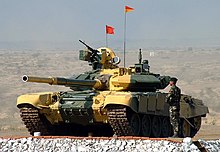
Russia Rubbishes Claims Of Fraud In T-90 Dealings With India

Moscow is puzzled over Indian media rumors claiming that Russia refuses to fulfill a decade-old contract on licensed production of T-90S main battle tanks in India, a Russian defense industry source said.

“The Russian side is timely and completely fulfilling all agreements with India on the licensed production of T-90 tanks, including the delivery of all necessary components and the transfer of technical documentation,” the source said on Tuesday.

India’s Business Standard said on November 28 that the licensed production of T-90 tanks was “hamstrung by Moscow’s obstruction in transferring technology and the Russian-built assemblies needed even for the India-built tanks.”

“It is difficult to say why these allegations have emerged,” the Russian source said, adding that all controversial issues on the arms contracts with India are promptly resolved by the Russian-Indian intergovernmental commission on military-technical cooperation.

Russian diplomatic sources in India believe that the media rumors reflect the attempts by the Indian side to shift the responsibility for its own inability to manage the production of sophisticated military equipment.

India ordered 310 T-90s in 2001 following delays in the manufacturing of the indigenous Arjun main battle tank and Pakistan's decision to purchase the T-80 from Ukraine. A contract was also signed for the licensed production of another 1,000 T-90s.

Initial disagreements with Russia over transfer of technology were resolved at the end of 2008, according to official statements on both sides.

Only 150 T-90S have been built so far at the Heavy Vehicle Factory (HVF) in Avadi, Chennai.

Russian Duplicity At Its Best Or Clear Case Of Swindling

The following report was published in one of the defense blogs and now I know why India went for Arjun tanks and not T-90. This report clearly shows why slowly but surely Russia is loosing defense market of India to the French,Americans and The Israeli's

Wednesday, 9 November 2011

NATO Scrambles F-16's To Intercept Russian Air Force Planes Over Baltic

4 NATO F-16 fighters jets were scrambled Nov. 7 as four Russian air force planes came perilously close to the territory of the Baltic states.

Defense ministry spokeswoman Ugne Naujokaityte said that four Danish F-16 fighters, which currently police the skies of Lithuania, Latvia and Estonia, took to the air twice to escort the Russian planes.

This area experiences very low frequency of Russian Air Force activity thus it was a bit of a shock to see this happening. Two AN26 transport aircraft and a TU134 bomber flew in succession from Russia's Baltic territory of Kaliningrad to Russia itself, and an IL20 intelligence-gathering plane flew in the opposite direction.

Baltic states that broke away from their communist masters have a professional army but lack a potent Air Force thus NATO countries agreed to police their skies in rotation. Denmark took over from France last month to patrol the skies of Lithuania.

The line between navigational error and Russian "buzzing" of the Baltics can be hazy, experts say. While the planes involved in Monday's incident did not actually cross into the Baltic states' airspace, it comes amid growing disquiet about a Russian build-up in the region.

This news becomes more significant in the light of the fact that Russian have bolstered the Kaliningrad defense structure by deploying a brigade of marines, and deployed a new anti-aircraft missile system sweeping the Baltic states and Poland.

Sunday, 18 September 2011

U.S. to deploy ballistic missiles in Poland by 2018

The United States will deploy elements of a missile defense shield in Poland by 2018, the U.S. and Poland said in a joint statement on Thursday.

"The United States and Poland are pleased to jointly announce that the Ballistic Missile Defense Agreement of 2008 and its Amending Protocol of 2010 on deployment of the land-based SM-3 system within Poland has entered into force, effective of September 15, 2011," the statement said.

The system will be located at the Redzikowo military base, the statement added, calling it "a significant contribution by our two nations to a future NATO missile defense capability."
Russia has retained staunch opposition to the deployment of missile-defense systems near its borders, claiming they would be a security threat.

NATO says it needs the shield, which will be eventually deployed in the Mediterranean, Poland, Romania and Turkey, to counter the threat of missile attacks from Iran.

Saturday, 27 August 2011

MiG Denies Helping China In J-20 Black Eagle Project

Russia has never transferred any stealth technology to China to assist it with its J-20 Black Eagle fifth-generation stealth fighter prototype, Russian plane maker MiG said on Friday.
"We are not delivering any equipment to China, and never have," MiG spokeswoman Yelena Fyodorova said.

MiG's statement follows claims in the Russian and foreign press last week that China's J-20, unveiled over six months ago, is based on technology and components from the Russian Mikoyan Article 1.44, a stealth technology demonstrator aircraft, development of which was suspended.
Some analysts say the aircraft have close similarities.

"The back end of the J-20 looks awfully like the 1.44, as does the overall layout with delta canards," said Douglas Barrie, an air warfare specialist at the London-based International Institute of Strategic Studies.

"If it's a coincidence, it's a striking one. Russia may have provided technical support, but there is nothing substantial to prove that. China has however relied on Russia for much of its defense procurement for a decade and a half," he added.

China's J-20 Black Eagle is thought to be conceptually similar to the U.S. F-22 Raptor and the Russian T-50 jets, but is likely to be just a technology demonstrator or prototype rather than a viable fighter.

China has been working on a future fighter program since the mid-1990s, but the J-20 is not expected to enter service before 2018-2020.

Earlier in the month, Mikhail Pogosyan, the head of Russia's United Aircraft Corporation said that China's fifth-generation fighter program is more for effect than substance and branded the maiden flight as a "show-off."

China relied on the Soviet Union for much of its aviation technology until the Sino-Soviet split after 1961. China then carried on developing copies of Soviet and Russian aircraft.

Beijing also relies on Russian engines, radars and electronic components for many of its other aircraft, such as the JF-17 fighter it developed jointly with Pakistan.

Friday, 8 July 2011

Russia Catches A Chinese Spy Trying To Smuggle Parts Of Su-27 And Mig-29 To China

courtesy wikipedia
China is at it again, trying to steal what is not its. This time it is the Russian fighter plane parts. I wonder what they are up to in India

Customs authorities in Russia's Far East have launched a criminal case against a Chinese citizen who attempted to smuggle spare parts for Russian MiG-29 and Su-27 fighters last year, a customs' spokesperson said on Friday.

The man, whose identity has not been revealed, was caught at one of the border checkpoints in Transbaikal region in July last year. Customs officials found six stepping motors, two piston pumps, 54 connectors, an elapsed-time meter and other parts in the trunk of his car.

"It took experts from the Defense Ministry almost a year to prove that the confiscated equipment is part of assembly kits for MiG-29 and Su-27 fighter jets," Yulia Philipova said."A criminal case has been opened," she said.

It is the second attempt by Chinese nationals to smuggle spare parts for fighter jets from Russia in the past three years.

A Chinese man was detained at the same border checkpoint in 2009 while trying to smuggle power supply circuits for Su-27s.

China is notorious for producing copycat versions of military equipment from all over the world.
Russia has accused China of producing its own clones of some Russian-made weaponry, including the Su-27SK fighter jet, in violation of intellectual property agreements.

(source Rio Novosti)

Russia To Pump $730 Billion In New Weapons

courtesy scrapetv.com
Russian Prime Minister Vladimir Putin has announced his government plans to spend hundreds of billions of dollars on weapons modernization by 2020. In his address to parliament earlier this year, Putin said Russia must be strong enough to fend off any threats from abroad, so missile production will double starting in 2013. Analysts in Moscow say this ambitious plan is intended mainly to preserve the government's domestic and regional influence.

Upgrade

Russia plans to spend $730 billion by 2020 to upgrade and re-arm its military. That's nearly $20 million a day.

The new state arms procurement program includes purchases of eight missile-carrying strategic submarines equipped with Bulava ballistic missiles. Plus 600 aircraft and S-400 and S-500 air defense systems. The arms purchases, both at home and abroad, would allow Russia to raise the proportion of modern weaponry in its arsenal to 70 percent by 2020.
Independent military analyst Pavel Felgenhauer says upgrading the strategic nuclear forces is at the top of the list, but the rest of the military needs a boost as well.
"Then there's of course the air force, the air defense system, the army - actually, everything needs re-arming because right now they say that [only] 10-15 percent of our weaponry is modern," Felgenhauer noted.

Budget increase

As Russia exports weapons worth billions of dollars abroad, the country's armed forces are mostly equipped with outdated Soviet-era weaponry. In the last 10 years the government has increased the defense budget tenfold, says Felgenhauer, but still failed to bring the military up to date.

"Now the present defense minister says that there was massive misappropriation of funds," Felgenhauer added. "The Russian defense industry, which is also downgraded, and its capabilities are much smaller than in Soviet times, responded to more funding by just raising prices. They are producing the same several fighters or missiles, but for a much bigger price."
Foreign threats

Prime Minister Putin says it is necessary to spend billions on re-arming the military due to the need to fend off foreign threats. But while that will demonstrate Russia's military might, analysts say the main goal really is to create more business for the country's military-defense complex ahead of next year's presidential and parliamentary elections.

"Russia has inherited a large military-industrial potential and unfortunately, no real conversion from the military production to the civil production has occurred," noted Yevgeny Volk, a political analyst Yeltsin Foundation in Moscow. "So [the military spending plan is necessary] in order to provide more working places, more jobs, more people involved in this production who are really the electorate for Mr. Putin pending the parliamentary and presidential elections in Russia."

The new proposed arms import plan is expected to come in two stages. In the first, Russia would purchase equipment and licenses, and in the second, it would set up joint ventures with Western arms providers, and begin production of Western-designed weapons systems inside the country.
In post-Soviet Russia, analysts say, "military" mostly means "business" - no matter what ideological wrapping it has.

(source Voice Of America)

Saturday, 2 July 2011

Russia May Delay Indian Missile Frigate Delivery, So What Is New?

The age old problem with the Russian industry is cropping up as usual. These are the exact reasons why slowly India has started buying military hardware from other countries.

Russia is not going to meet the deadlines in the implementation of a contract on the delivery of missile frigates to the Indian Navy, the state-run arms exporter Rosoboronexport said.

Russia and India signed a $1.6 billion contract on construction of three modified Krivak III class (also known as Talwar class) guided missile frigates for India in 2006. The first frigate was scheduled for delivery in April 2011.

"There is a delay, and it is hard to say now what the new deadline is going to be, although the first ship is undergoing dockside trials," said Oleg Azizov, head of Rosoboronexport's delegation at the IMDS naval show in St. Petersburg.

Russia's Yantar shipyard, which is building the ships, has asked Rosoboronexport for additional $100 million to finish the construction.

Azizov said an Indian Navy delegation will arrive in Russia next week to negotiate the new deadlines for construction.

This is the second time Russia has run into difficulties with Indian naval contracts. The price of the Admiral Gorshkov aircraft carrier has been raised almost twice, and its delivery date was put back from 2008 to late 2012.

Russia has previously built three Talwar-class frigates for India - INS Talwar (Sword), INS Trishul (Trident), and INS Tabar (Axe).

The new frigates each will be armed with eight BrahMos supersonic cruise missiles, jointly developed by Russia and India.


(source Rio Novosti)

Russia To Try Its Luck In Indian Submarine Tender


Russia will participate in a new tender on the delivery of six diesel-electric submarines for the Indian Navy, the state-run exporter Rosoboronexport said.

Russia dropped out of the first Indian submarine tender in 2009.

"There is a new tender, with the new requirements, and together with [Russia's] Rubin design bureau we are making a proposal to India for Amur 650 class submarines," Azizov told reporters at IMDS-2011 naval show in St. Petersburg on Friday.

Azizov said that Amur class is a fourth-generation vessel, and "Russia has all chances to win the tender."

The Indian Navy said in February it will announce a global tender for procuring six next generation submarines worth about $11 billion by the end of 2011.

India is building six Scorpene submarines the Mazgaon Dockyards Limited (MDL) under a deal with France's DCNS. However, the Indian side said it would need submarines "with better stealth capability, improved detection range and combat management system."

According to Azizov, Amur class subs match these requirements perfectly, as their sonar signature level is several times less than that of Kilo class submarines which are considered at present the most silent in the world.

In addition, Amur 650 could be equipped with the Air Independent Propulsion (AIP) systems on the basis of fuel cells to increase considerably the endurance and cruise range in a submerged state.

According to Indian sources, France, Germany and Spain will also participate in the tender.
The Indian Navy is planning to commission at least 12 submarines in the next decade to strengthen its depleted submarine fleet.
(Source Rio Novosti)

China Nothing Original About It Everything Is A Cheap Copy


(Research Devashish Bajpai)
China has built a domestic copy of the famed Su-27 Flanker fighter and may compete with Russia on third-party markets if it sets up the full-scale production of the plane, according to Russian media.

China has acquired 76 Su-27SK fighters from Russia since 1992, and bought a license for production of another 200 planes in 1995, in a deal worth $2.5 billion.

"Since 1996, the domestic version of the Su-27 aircraft, dubbed J-11, has been produced at the Shenyang Aircraft Corporation (SAC) with the use of Russian components," the Vedomosti newspaper said.

The licensed production of the Su-27 has given China its most capable fighter aircraft while also providing a vehicle for its industry to gain knowledge of third-generation fighter manufacturing, Vedomosti said.

About 95 aircraft had been produced in China by 2003. However, the 1995 agreement did not include the transfer of avionics and AL-31F turbofan engine technology, and the Chinese manufacturers had to rely on the Russian supply of these systems. Contract for the remaining 105 is still pending. It is believed that Russia cancelled the arrangement in 2006 after it discovered that China had reverse-engineered the technology and was developing an indigenous version, the J-11B.

Pakistani navy is very interested in buying J-11B for itself, latest report from Pakistan indicate that they are trying to negotiate a deal with the Russians, who are already smarting under the rejection of MiG-35 by the Indians.


India to get nuclear submarine from Russia by year end

The Russian Navy will hand over its newly-built nuclear submarine to India on a 10-year lease by the end of this year, the Russian Naval Chief today said.

"We will hand this submarine to the client by the year end," Naval Chief Admiral Vladimir Vysotsky was quoted as saying by RIA Novosti.

"The Indian crew is absolutely prepared for operating the submarine," he said.

Last month, a top official of the Defence Cooperation Service said the Indian naval crew was already on board the K-152 Nerpa nuclear submarine and was carrying out pre-delivery trials on the high seas.

The lease contract for the submarine is estimated to be between USD 650-900 million.

The Nerpa was to be inducted into the Indian Navy by November, 2008. But shortly after the sea trials commenced, as many as 20 sailors and technical workers were killed onboard, while they were asleep, due to the release of toxic Freon gas following a technical problem in the automatic fire suppression system in the vessel.

Sunday, 26 June 2011

MIG-29 Kub Crashes In Russia, Aftershocks Felt In India


Two pilots were killed on Thursday when a Russian Air Force MiG-29Kub fighter jet crashed in the Astrakhan region of Russia on Thursday, law enforcement sources said.

“At 4.43 p.m. the aircraft went off the radar screens around 43 km from the town of Akhtubinsk in Astrakhan region,” the source said.

The crash site has been located and an Mi-8 rescue helicopter is on its way to the site.
Akhtubinsk is home to the Russian Air Force’s test and tactical evaluation center, but it is not yet known if the aircraft came from that base.

The defense ministry of Russia has grounded the entire Mig-29K fleet with immediate effect. This has left the Indian defense establishment really jittery because Russia and India signed a contract in 2004 for the delivery of 12 single-seat MiG-29K and four two-seat MiG-29KUB fighters to be deployed on the Admiral Gorshkov, currently being retrofitted in Russia for the Indian Navy.

The Indian Navy is planning to use a total of 45 MiG-29Ks, including the 16 stipulated under the 2004 contract with Russia.Until 2010 India has received 11 of the first batch.

Now the government of India has asked from the Russians as to the nature of the crash and the reason behind grounding of the fleet. It is suspected that some kind of major flaw has been found, thus forcing even the Russians to ground their own fleet. This time they cannot blame HAL for faulty spares or Indian Pilots for incompetence. Unfortunately keeping with the new Russian mantra of cold shouldering its main buyer and ignoring all attempts by the Indians to mend fences, they have kept mum on this issue and have refused to comment thus far on the accident.

Wednesday, 15 June 2011

Russian Kamov Vs U.S Apache Helicopter Simple Video

A simple video made by most probably a Russian which compares the vital stas of Russian Attack Helicopter Kamov vs U.S Helicopter Apache.


Sunday, 12 June 2011

Russia Uncomfortable With U.S Warship Presence In Black Sea Naval Exercise

Foreign Ministry Of Russia on Sunday made it clear that Russia was not happy with the presence of US guided missile cruiser Monterrey equipped with the AEGIS ballistic missile defence system in the Ukrainian-U.S. naval drills called Sea Breeze 2011 in the Black Sea.

"While leaving aside the unsettled issue of a possible European missile shield architecture, Russia would like to know, in compliance with the Russia-NATO Lisbon summit decisions, what 'aggravation' the U.S. command meant by moving the basic strike unit of the regional missile defense grouping being formed by NATO in the region, from the Mediterranean to the east," the ministry said in a statement.


“The Russian side has repeatedly stressed that we shall not leave unnoticed any elements of U.S. strategic infrastructure in the immediate vicinity of our borders and that we shall take such steps as a threat to our security,” the ministry said in its statement. “We have to state that our concerns are still being ignored and that screened by talk about cooperation in the area of anti-missile defence this very anti-missile shield configuration is being formed in Europe, while we have repeatedly warned our U.S. and NATO partners about its dangerous consequences. Moreover, it is being done blatantly as though to demonstrate Russia that no one is going to take its opinion into consideration. Such an approach in no way promotes joint efforts to outline the concept and architecture of the future missile defence system in Europe, as was agreed in Lisbon and at meetings between the Russian and U.S. presidents.”

"The mere fact that the very first phase of the U.S. administration’s ‘adaptive approach’ is accompanied by such ‘surprises’ testifies to the high level of strategic vagueness the U.S. missile defence program creates,” the Russian Foreign Ministry went on. “The question is quite logic whether oral warranties that it is not targeted against Russia could be trusted.”

“U.S. missile cruiser’s reconnoitering of the Black Sea waters once again proves the necessity to spell out clear legal guarantees that anti-missile defence infrastructure that is being deployed in Europe is not targeted against Russia’s nuclear deterrence potential. Such guarantees should be based on objective criteria making it possible to see to it that missile defence systems meet their stated goals, i.e. to repel missile threats originating from outside Europe. It is likewise vital to ensure Russia’s equal participation in the development of the concept and architecture of the European missile defence system and to work out relevant measures of building up trust and transparency,” the statement said.

According to the ministry's statement, Monterrey was sent to European waters as part of the U.S. administration's phased adaptive approach to building the European segment of the global missile shield. The program's first stage envisages the deployment of a group of U.S. warships in the Adriatic, Aegean and Mediterranean Seas to protect South Europe from possible missile strikes.

This according to the Russians is aggravating the matters related to the already complicated European Missile Shield Plans. The problem is that Poland and Romania are important sites to detect and defend against Iranian missiles but same sites can be used against Russian missiles too thus nullifying Russian capability against the western powers.

Wednesday, 8 June 2011

India And Russia Will Start Producing Equipment For Nuclear Power Plants Together

A Russian-Indian joint venture for the production of equipment for nuclear power plants (NPP) will be set up in India before the end of the year, Director General of the AtomEnergoMash Company Vladimir Kashchenko said on the sidelines of the International Atomexpo-2011 Forum that opened in Moscow.

In his words, the joint venture will be set by an Indian enterprise, which is ready to produce NPP equipment under Russia’s technologies.

“Currently, India has got several enterprises of rather high technological market, which may become participants in the Russian-Indian joint venture,” Kashchenko said.

“In addition, India is a very promising market of nuclear technological equipment for the entire Asian region,” he stressed.

The AtomEnergoMash director general is confident that the joint venture of the kind is “the prototype for the setting up of a regional structure for the production of atomic technological equipment, which may be exported to other countries of the region.”

“If the Asian market of nuclear technologies develops rather intensively, then the Russian-Indian joint ventures will be very interesting and promising project, which will be beneficial both for India and Russia,” Kashchenko said.

In his words, “the project of the joint venture has always been coordinated in full. It is expected that the first supply contracts will be ready this year.”

Touching upon the AtomEnergoMash’s economy, Kashchenko said that this year’s portfolio of orders is estimated at 80 billion roubles (USD 1 = RUB 27.77). as well as 50 percent of all orders are projects of the atomic industry.

(source Itar Tass)